
In our previous article titled Seattle Fumbled Kickstarting Lagging Residential Construction, we discussed the MHA Accelerator. The MHA Accelerator was a program which would have reduced the onerous Mandatory Housing Affordability (MHA) fees by 90% for a set duration of 5 years. We are currently experiencing rising interest rates, increasing inflation and increasing construction cost. As a result, even though we have a housing shortage, construction has slowed to a crawl. The MHA Accelerator would have been a boost to kickstart our sagging building industry.
Christopher Jones Architects had already felt the impact of the potential MHA Accelerator legislation. Not only were we getting inquiries about new projects in LR zones, but also contacted by current clients regarding permit issuance for their long dormant, permit ready, LR zoned projects. All that remained was paying for permits and a potentially much lower set of MHA fees. Of course, all that stopped with the death of the original MHA Accelerator legislation. Well, maybe not quite so dead after all…
The MHA Accelerator has Returned?!
On Wednesday Sept 16th, we received notice from the Master Builders Association of King and Snohomish County (MBAKS) stating that MHA was back on the table, and they were asking for volunteers to testify at the coming Friday city council committee meeting, giving us only two days to prepare. The proposed legislation is as follows:
MHA Accelerator.
Draft Ordinance: A temporary two-year reduction in MHA requirements. This includes an 80% reduction for vested projects, and a 60% reduction for new projects that intake within one year.
MHA in Neighborhood Residential
Draft Resolution: This outlines the council’s intent to study adding MHA penalties to NR Zones.
While glad to see the discussion resurrected, the terms of the fee reduction were a disappointment, while considering adding MHA to NR zones was infuriating! Prior to MHA, the vast majority of our infill residential projects were in LR zones. That work withered and disappeared once this poorly designed tax on housing was put in place, and the shift away from what was our bread-and-butter work has been painful.
We should not lower the reductions in MHA fees, they should be eliminated altogether while better less damaging methods of addressing affordable housing are considered. The draft resolution is even worse. How could the council consider expanding a program that has caused so much damage? Based on this, we decided we should show up and let our voice be heard.
Testify!
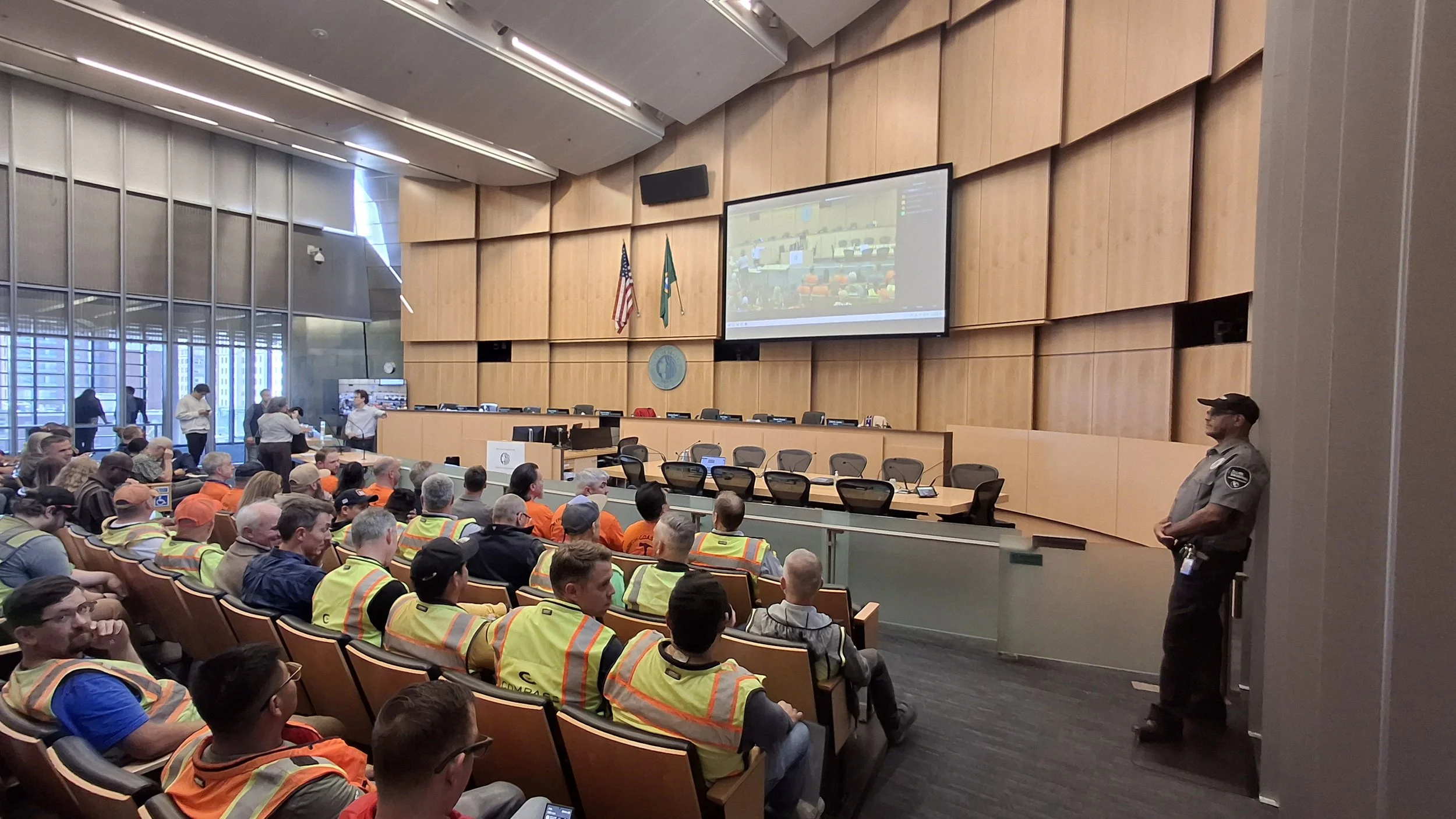
I am ashamed to admit that I had never before stepped foot in Seattle City Hall, so I had no idea where the Council Hall was. However, it was not hard to find, since all I had to do was follow the crowd. The unions had shown up in force!
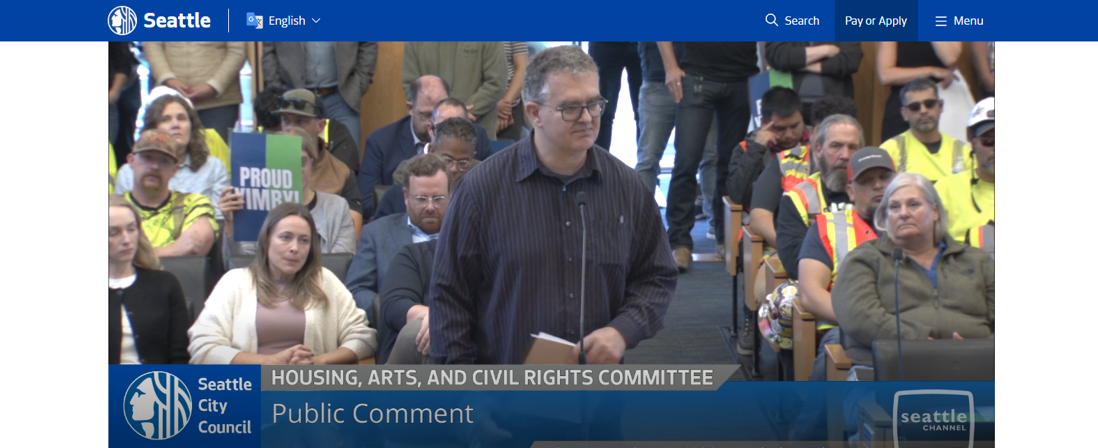
After signing up, I found a place to stand and wait my turn. When the meeting was called to order, it was announced that we would be given 1 minute each, with a bell at 50 seconds and your mic cut after 1 minute. Even though this was a procedural meeting, I was disappointed to see only four council members showed up to hear from their constituents. Present were Joy Hollingsworth, Eddie Lin, Alexis Mercedes and Dionne Foster. Here is a link to the council meeting video: https://www.seattlechannel.org/videos?videoid=x190372
There were fifty people who signed up to testify in person, in addition to four virtual testimonials. Our e-mail from the previous day said that we would have 2 minutes to testify, and I had practiced my remarks to complete them in about 1:30, so obviously I had to do some editing on the fly. This was intense for someone who does not practice public speaking often. Even so, I made it through my remarks within the allotted time. The lady next to me said I did a good job as did the people watching from the office. My complete 2-minute remarks are below.
Draft ordinance — the "MHA Accelerator."
Introduction: I am Lance Oyler, a principal with Chrsitopher Jones Architects, a Seattle residential design firm. The majority of our work is in-fill residential/middle housing.
Concerns: Prior to MHA, townhouse projects in LR zones were 90% or more of our work. Now it is about 5%-10%. Almost every project we designed in an MHA zone over the last few years has either been cancelled, put up for sale or is currently on hold, with nothing new on the horizon. We had some potential work when MHA accelerator was first discussed. That has since disappeared.
Recommendations
We recommend that MHA be eliminated, especially for small projects. Performance is not an option for this type of project. In lieu of that, a 90% reduction would be best, but we do not feel that a 60% reduction would move the needle for our clients who are struggling to make projects pencil without MHA.
Draft resolution — MHA in Neighborhood Residential.
Concerns: We have watched as MHA crippled housing production in Seattle’s LR and RSL zones. We do not want to see the same happen in the NR zone. Thanks to Middle Housing Legislation our work in NR zones is a small bright spot in an otherwise difficult economy. This resolution stands in direct opposition to the housing problems Seattle faces and that middle housing legislation and the MHA accelerator seek to address.
Recommendation: Do not make an already difficult situation even worse by imposing MHA on the NR Zone. Please do not move forward with this study and do not burden the city with a fix that has been proven not to work. You cannot collect MHA fees for projects that are not built.
What’s next?
By my count about 47 of the people who testified were in favor of reducing MHA. Four of those who testified were affordable housing advocates and against any reduction to MHA. Three of those who testified were on a different wavelength entirely. Not everyone spoke regarding expanding MHA to the NR Zone as it was just a study at this point. The city council members who were in attendance were clearly in support of the legislation, particularly Dionne Foster and Eddie Lin who are co-sponsors of the MHA Accelerator legislation. Debate on the MHA Accelerator legislation will begin late this year and continue into early 2027. We hope the final legislation will increase MHA relief and increase the duration over what is currently proposed and will be in place by the end of May. We feel that the current proposed MHA Leglislation could go further. You do not have to testify to show your support to the council. Instead, reach out to your council person. Let them know you support the MHA Accelerator but it needs to go further.
- Lance Oyler